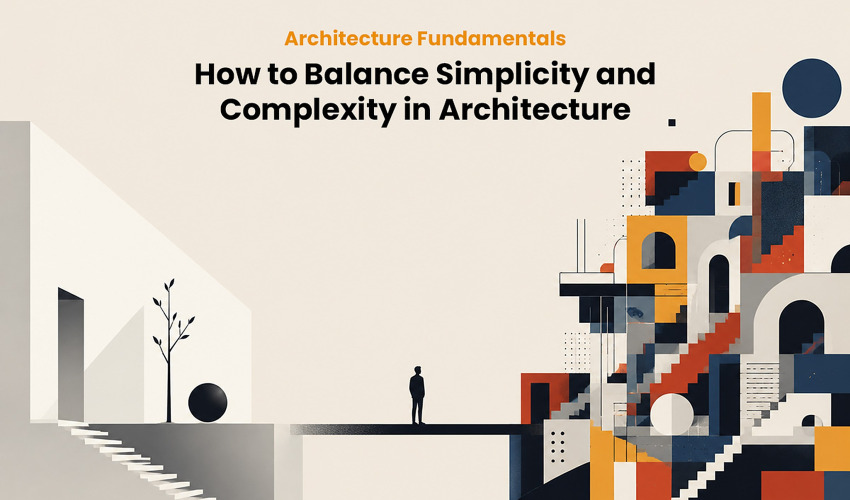
Minimalism vs Complexity in Design
Get access to all learning content and every RTF Academy course with RTF Academy Pro
Less is not always more.
Sometimes more is more.
Explore the great tug-of-war of design philosophy and learn when to strip back, when to layer up, and how to commit with total conviction.
You’ll know when to simplify and when to layer.
- Choose your battles wisely — know when restraint serves a project and when it starves it
- Simplify without emptiness — strip designs back while keeping their warmth and meaning
- Layer without chaos — add richness and detail that deepens rather than clutters
- Understand both camps — argue each philosophy well enough to defend either one
- Find your own position — develop a stance that makes your work recognizably yours
- Judge work fairly — critique any project on its own terms instead of your bias
Built by one of the most-read architecture platforms in the world.
RTF | Rethinking The Future has spent over a decade publishing the ideas, projects and voices shaping architecture — and now brings that depth to learning. Every course is researched, written and produced by the RTF team.
Pick a side. Or better, master both.
A clear path. Six steps.
Everything unlocks instantly with membership · learn at your own pace
If you see yourself here, start today.
A few hours from now, you could already see differently.
I swung between stripping everything away and adding too much, with no idea where to stop. Understanding what minimalism and complexity each actually demand gave me a way to decide deliberately. My recent work finally feels resolved instead of unfinished or overworked.
Simple by design.
Watch
Short, focused video lessons — each one a single idea, clearly explained.
Apply
End every lesson with a small task that pushes your real project forward.
Transform
Watch your work develop a point of view that is unmistakably yours.
Answered simply.
I already have a strong minimalist style. Will this challenge or confirm it?
Both. You'll understand why minimalism works when it does, and gain the judgment to know when a project demands richness instead.
Is this theory-heavy?
It's judgment-heavy. Theory appears only where it changes decisions, always through built examples you can analyze.
Do I need any prior experience?
No. Every course starts from where you are and builds up step by step, in plain language.
Is this software training?
No — software changes yearly. The thinking you learn here lasts a career.
How does it work?
Short video lessons with a small practice task after each. Any device, your pace.
What does membership include?
One membership unlocks every course on RTF Academy — all 450+, nothing sold separately. And you stay in control: cancel anytime in one click, and you will never be charged again.
Ready to see your work change?
Your next project could be the one that feels truly yours.
- 6 Sections
- 25 Lessons
- 4 Hours
- Understanding Design Philosophies4
- Historical Evolution of Design Styles4
- Visual & Spatial Principles4
- User Experience & Emotional Impact4
- Contemporary Applications4
- Balancing Design Approaches5
Reviews
Online and at your own pace.
Get access to all learning content
and every RTF Academy course with RTF Academy Pro
I swung between stripping everything away and adding too much, with no idea where to stop. Understanding what minimalism and complexity each actually demand gave me a way to decide deliberately. My recent work finally feels resolved instead of unfinished or overworked.
You might be interested in
-
0 Students
-
25 Lessons
-
0 Students
-
25 Lessons
-
0 Students
-
25 Lessons
-
0 Students
-
25 Lessons
-
0 Students
-
25 Lessons
-
0 Students
-
25 Lessons