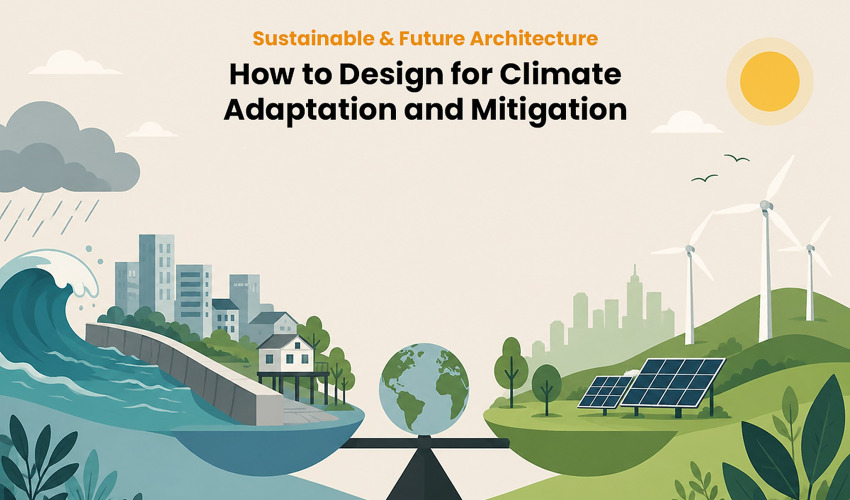
Climate Adaptation vs Mitigation
Get access to all learning content and every RTF Academy course with RTF Academy Pro
The debate confuses even experts.
You will settle it with ease.
Should a design brace for change or help prevent it? Understand the rival climate strategies, where they differ, and how the wisest projects embrace them together.
You’ll know if a site needs adapting or protecting.
- End the confusion — finally keep the competing strategies straight and explain them clearly
- Match strategy to site — judge which approach a project and its place genuinely need
- Combine them cleverly — design schemes that prepare for change while reducing harm
- Argue with precision — use the right term at the right moment in serious discussions
- Evaluate real projects — critique built work through a sharper, better informed climate lens
- Advise beyond buildings — contribute meaningfully to city and policy conversations around you
Built by one of the most-read architecture platforms in the world.
RTF | Rethinking The Future has spent over a decade publishing the ideas, projects and voices shaping architecture — and now brings that depth to learning. Every course is researched, written and produced by the RTF team.
Clear thinking about climate is a career edge.
A clear path. Eight steps.
Everything unlocks instantly with membership · learn at your own pace
If you see yourself here, start today.
A few hours from now, you could already see differently.
I used adaptation and mitigation interchangeably, which embarrassed me in a panel discussion once. The frameworks here clarified when each applies and how they shape different design responses. My climate strategy sections finally have real structure.
Simple by design.
Watch
Short, focused video lessons — each one a single idea, clearly explained.
Apply
End every lesson with a small task that pushes your real project forward.
Transform
Watch your work develop a point of view that is unmistakably yours.
Answered simply.
Aren't adaptation and mitigation just policy terms with no design relevance?
They drive opposite design decisions — what you build, where, and how robustly. Confusing them produces buildings that solve the wrong problem.
Who is this most useful for?
Anyone shaping the built environment under climate pressure — architects and urban designers especially, since they sit exactly where the tension between the strategies plays out.
Do I need any prior experience?
No. Every course starts from where you are and builds up step by step, in plain language.
Is this software training?
No — software changes yearly. The thinking you learn here lasts a career.
How does it work?
Short video lessons with a small practice task after each. Any device, your pace.
What does membership include?
One membership unlocks every course on RTF Academy — all 450+, nothing sold separately. And you stay in control: cancel anytime in one click, and you will never be charged again.
Ready to see your work change?
Your next project could be the one that feels truly yours.
- 8 Sections
- 25 Lessons
- 4 Hours
- Understanding Climate Change Fundamentals3
- Climate Mitigation Strategies3
- Climate Adaptation Strategies3
- Resilient Urban Planning3
- Technology & Innovation3
- Policy, Economics & Ethics3
- Comparative Analysis & Decision Making3
- Future Outlook & Applications4
Reviews
Online and at your own pace.
Get access to all learning content
and every RTF Academy course with RTF Academy Pro
I used adaptation and mitigation interchangeably, which embarrassed me in a panel discussion once. The frameworks here clarified when each applies and how they shape different design responses. My climate strategy sections finally have real structure.
You might be interested in
-
0 Students
-
25 Lessons
-
0 Students
-
25 Lessons
-
0 Students
-
25 Lessons
-
0 Students
-
25 Lessons