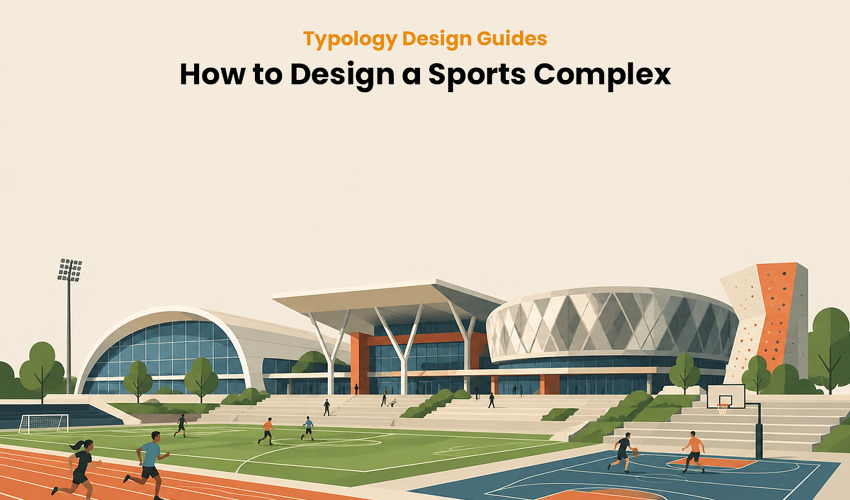
How to Design a Sports Complex
Get access to all learning content and every RTF Academy course with RTF Academy Pro
Champions train somewhere ordinary.
It does not have to be.
Discover how to design places where communities move, compete, and gather, buildings that earn love from serious athletes and casual visitors alike.
Whole sporting worlds will fit tight sites for you.
- Design for active life — for every age, sport, and skill level walking through the doors
- Combine many facilities — into one coherent, welcoming whole that feels effortless to navigate
- Motivate through space — so ordinary people actually want to come back again tomorrow
- Plan durable and practical — for hardworking buildings that take a daily beating and survive
- Win community sport work — the kind of steady commissions that flow reliably across regions
- Champion healthy cities — one genuinely well-designed and well-loved facility at a time
Built by one of the most-read architecture platforms in the world.
RTF | Rethinking The Future has spent over a decade publishing the ideas, projects and voices shaping architecture — and now brings that depth to learning. Every course is researched, written and produced by the RTF team.
Active communities need great venues. Design them.
A clear path. Five steps.
Everything unlocks instantly with membership · learn at your own pace
If you see yourself here, start today.
A few hours from now, you could already see differently.
I kept designing sports complexes as separate boxes connected by leftover space. The course reframed the complex as a shared-infrastructure problem, from changing village logic to court orientation rules. My scheme now clusters programme intelligently and the running costs argument writes itself.
Simple by design.
Watch
Short, focused video lessons — each one a single idea, clearly explained.
Apply
End every lesson with a small task that pushes your real project forward.
Transform
Watch your work develop a point of view that is unmistakably yours.
Answered simply.
How is a sports complex different from a stadium?
It is a village, not a bowl — multiple venues, shared services, training and community use on a single site. The course focuses on that masterplanning challenge.
Is this relevant to school and community sports facilities?
Very. Most sports architecture happens at community scale, and the course keeps its methods grounded there as well as in elite venues.
Do I need any prior experience?
No. Every course starts from where you are and builds up step by step, in plain language.
Is this software training?
No — software changes yearly. The thinking you learn here lasts a career.
How does it work?
Short video lessons with a small practice task after each. Any device, your pace.
What does membership include?
One membership unlocks every course on RTF Academy — all 450+, nothing sold separately. And you stay in control: cancel anytime in one click, and you will never be charged again.
Ready to see your work change?
Your next project could be the one that feels truly yours.
- 5 Sections
- 25 Lessons
- 4 Hours
- 1. Understanding the Type5
- 2. Brief, Programme and Areas5
- 3. Planning and Circulation5
- 4. Codes, Comfort and Systems5
- 5. Getting It Built and Judged5
- 5.1Structure and materials for a sports complex
- 5.2Cost drivers and value-engineering traps
- 5.3Operations: how a sports complex works on day 3,000
- 5.4Case studies: Munich Olympic Park by Behnisch and Frei Otto, London Aquatics Centre by Zaha Hadid and the Beijing National Aquatics Centre by PTW and Arup
- 5.5The design checklist for a sports complex
Reviews
Online and at your own pace.
Get access to all learning content
and every RTF Academy course with RTF Academy Pro
I kept designing sports complexes as separate boxes connected by leftover space. The course reframed the complex as a shared-infrastructure problem, from changing village logic to court orientation rules. My scheme now clusters programme intelligently and the running costs argument writes itself.
You might be interested in
-
0 Students
-
25 Lessons
-
0 Students
-
25 Lessons
-
0 Students
-
25 Lessons
-
0 Students
-
25 Lessons