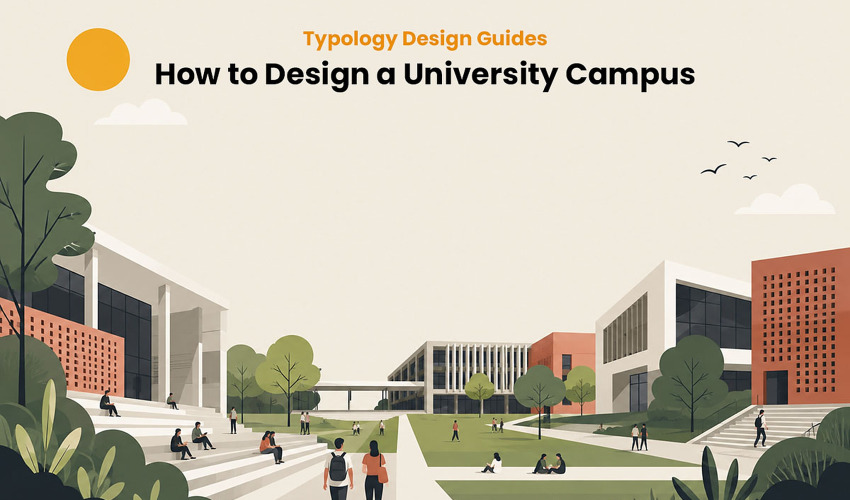
How to Design a University Campus
Get access to all learning content and every RTF Academy course with RTF Academy Pro
A campus is a city with a syllabus.
Someone has to design the city.
Learn to shape whole worlds of learning — places where movement, memory and community are designed, not accidental — and take on the largest briefs with total confidence.
Campus masterplans will stop overwhelming you.
- Think at city scale — plan grounds where whole communities live, study and cross paths daily
- Balance parts and whole — make individual buildings serve a bigger idea instead of competing with it
- Design for decades — create frameworks that grow gracefully as institutions change around them
- Shape outdoor life — turn the space between buildings into the heart of the place
- Guide movement naturally — let paths, gateways and landmarks do the wayfinding for you
- Win institutional trust — present masterplans that boards, users and cities believe in
Built by one of the most-read architecture platforms in the world.
RTF | Rethinking The Future has spent over a decade publishing the ideas, projects and voices shaping architecture — and now brings that depth to learning. Every course is researched, written and produced by the RTF team.
The biggest briefs go to those who think biggest.
A clear path. Five steps.
Everything unlocks instantly with membership · learn at your own pace
If you see yourself here, start today.
A few hours from now, you could already see differently.
Campus design defeated me because it is a building brief and a city brief simultaneously. Learning phasing logic, movement networks and the social geography of academic life gave me a structure for the scale. My campus masterplan finally grew from a framework instead of a frozen composition.
Simple by design.
Watch
Short, focused video lessons — each one a single idea, clearly explained.
Apply
End every lesson with a small task that pushes your real project forward.
Transform
Watch your work develop a point of view that is unmistakably yours.
Answered simply.
I've only designed single buildings — is campus-scale design a big leap?
It's a different mindset more than a harder one. You'll learn to think in networks, phases and open space, and your single-building instincts become the raw material.
Does this apply to smaller institutional campuses, not just huge universities?
Yes. The principles of legibility, circulation and growth planning scale down cleanly to colleges, school campuses and institutional precincts.
Is this useful if I lean toward urban design rather than architecture?
Very. Campus design sits exactly at that overlap, and the course treats masterplanning logic as seriously as building placement.
Do I need any prior experience?
No. Every course starts from where you are and builds up step by step, in plain language.
Is this software training?
No — software changes yearly. The thinking you learn here lasts a career.
How does it work?
Short video lessons with a small practice task after each. Any device, your pace.
What does membership include?
One membership unlocks every course on RTF Academy — all 450+, nothing sold separately. And you stay in control: cancel anytime in one click, and you will never be charged again.
Ready to see your work change?
Your next project could be the one that feels truly yours.
- 5 Sections
- 25 Lessons
- 4 Hours
- 1. Understanding the Type5
- 2. Brief, Programme and Areas5
- 3. Planning and Circulation5
- 4. Codes, Comfort and Systems5
- 5. Getting It Built and Judged5
- 5.1Structure and materials for a university campus
- 5.2Cost drivers and value-engineering traps
- 5.3Operations: how a university campus works on day 3,000
- 5.4Case studies: IIM Ahmedabad by Louis Kahn, Illinois Institute of Technology by Mies van der Rohe and Otaniemi Campus by Alvar Aalto
- 5.5The design checklist for a university campus
Reviews
Online and at your own pace.
Get access to all learning content
and every RTF Academy course with RTF Academy Pro
Campus design defeated me because it is a building brief and a city brief simultaneously. Learning phasing logic, movement networks and the social geography of academic life gave me a structure for the scale. My campus masterplan finally grew from a framework instead of a frozen composition.
You might be interested in
-
0 Students
-
25 Lessons
-
0 Students
-
25 Lessons
-
0 Students
-
25 Lessons
-
0 Students
-
25 Lessons