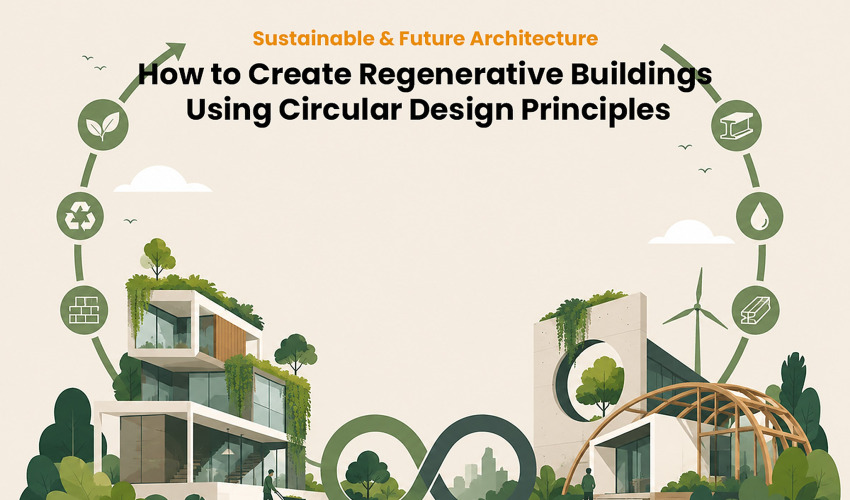
Circular & Regenerative Architecture
Get access to all learning content and every RTF Academy course with RTF Academy Pro
Buildings end up as rubble.
Yours could feed what comes next.
Imagine buildings designed like nature, where nothing is wasted and everything feeds something else. Step into the design philosophy that is quietly reinventing how architecture gets made.
Waste will become raw material in your design process.
- Design out waste — plan buildings whose parts live on long after demolition day
- Think in loops — replace take-and-discard habits with cycles that keep materials alive
- Give buildings second lives — design for disassembly, adaptation, and reuse from the very start
- Heal, not just sustain — aim beyond doing less harm toward actively restoring places
- Find circular materials — source and specify products designed to return and regenerate
- Pioneer the movement — position yourself at the front of a shift most peers have not noticed
Built by one of the most-read architecture platforms in the world.
RTF | Rethinking The Future has spent over a decade publishing the ideas, projects and voices shaping architecture — and now brings that depth to learning. Every course is researched, written and produced by the RTF team.
Waste was a design decision. Decide differently.
A clear path. Eight steps.
Everything unlocks instantly with membership · learn at your own pace
If you see yourself here, start today.
A few hours from now, you could already see differently.
Reduce and recycle was about as deep as my sustainability thinking went. The circular frameworks here pushed me to design for disassembly and material afterlives. My practice now writes material passports into project documentation.
Simple by design.
Watch
Short, focused video lessons — each one a single idea, clearly explained.
Apply
End every lesson with a small task that pushes your real project forward.
Transform
Watch your work develop a point of view that is unmistakably yours.
Answered simply.
Is circular architecture practical or still academic?
It's being built today — design for disassembly, material passports, reuse loops. You'll learn the versions that survive contact with real budgets.
How does regenerative differ from plain sustainable design?
Sustainable aims to do less harm; regenerative aims to leave the site and system better. The course makes that shift concrete and designable.
Do I need any prior experience?
No. Every course starts from where you are and builds up step by step, in plain language.
Is this software training?
No — software changes yearly. The thinking you learn here lasts a career.
How does it work?
Short video lessons with a small practice task after each. Any device, your pace.
What does membership include?
One membership unlocks every course on RTF Academy — all 450+, nothing sold separately. And you stay in control: cancel anytime in one click, and you will never be charged again.
Ready to see your work change?
Your next project could be the one that feels truly yours.
- 8 Sections
- 25 Lessons
- 4 Hours
- Introduction to Circular Thinking3
- Sustainable Materials & Resources3
- Design for Longevity & Adaptability3
- Design for Disassembly3
- Energy, Water & Ecological Systems3
- Waste-Free Construction Practices3
- Urban & Community Regeneration3
- Future Applications & Case Studies4
Reviews
Online and at your own pace.
Get access to all learning content
and every RTF Academy course with RTF Academy Pro
Reduce and recycle was about as deep as my sustainability thinking went. The circular frameworks here pushed me to design for disassembly and material afterlives. My practice now writes material passports into project documentation.
You might be interested in
-
0 Students
-
25 Lessons
-
0 Students
-
25 Lessons
-
0 Students
-
25 Lessons
-
0 Students
-
25 Lessons