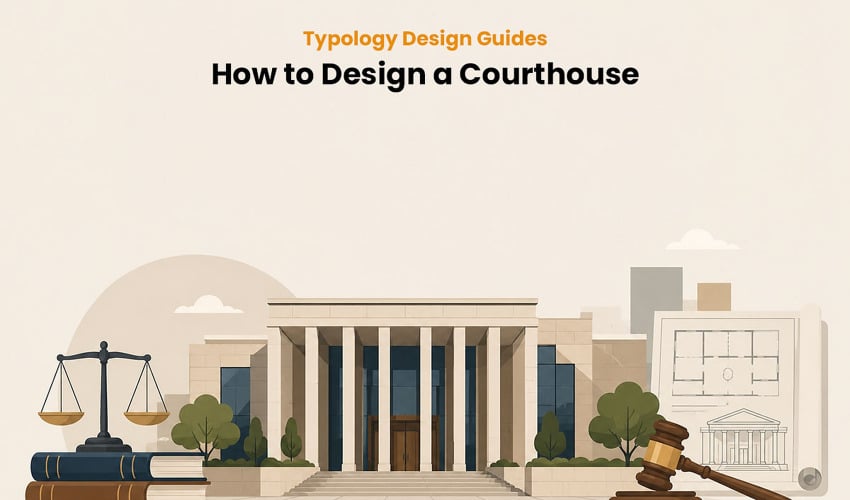
How to Design a Courthouse
Get access to all learning content and every RTF Academy course with RTF Academy Pro
Justice must be seen.
Buildings make it visible.
Learn to design civic buildings that balance authority with openness, where dignity, security, and public trust are built into the very walls.
Your courtrooms will carry gravity and warmth.
- Express civic gravity — without intimidating the very citizens it exists to serve
- Balance openness and security — inside a single building that genuinely needs both at once
- Design for solemn function — and for the people living through their hardest days inside it
- Pursue government commissions — with a confident civic vision that stands up to scrutiny
- Embed trust in architecture — in the buildings where society watches its values most closely
- Join the civic tradition — of dignified buildings that quietly define how democracy feels
Built by one of the most-read architecture platforms in the world.
RTF | Rethinking The Future has spent over a decade publishing the ideas, projects and voices shaping architecture — and now brings that depth to learning. Every course is researched, written and produced by the RTF team.
Civic landmarks need steady hands. Train yours.
A clear path. Five steps.
Everything unlocks instantly with membership · learn at your own pace
If you see yourself here, start today.
A few hours from now, you could already see differently.
Courthouses were a mystery of security lines and symbolism I had never studied. The course explained the three-stream circulation of public, custody and judiciary, and how dignity survives inside those constraints. I now read civic architecture with completely different eyes.
Simple by design.
Watch
Short, focused video lessons — each one a single idea, clearly explained.
Apply
End every lesson with a small task that pushes your real project forward.
Transform
Watch your work develop a point of view that is unmistakably yours.
Answered simply.
What makes courthouse design a distinct specialism?
It runs on strict separation — public, custody and judicial circulation must never cross — inside a building that must still feel open and just. The course teaches that balancing act.
Is this useful outside courthouse projects?
Yes. The security-versus-openness thinking transfers to embassies, civic buildings and any project where controlled flows meet public architecture.
Do I need any prior experience?
No. Every course starts from where you are and builds up step by step, in plain language.
Is this software training?
No — software changes yearly. The thinking you learn here lasts a career.
How does it work?
Short video lessons with a small practice task after each. Any device, your pace.
What does membership include?
One membership unlocks every course on RTF Academy — all 450+, nothing sold separately. And you stay in control: cancel anytime in one click, and you will never be charged again.
Ready to see your work change?
Your next project could be the one that feels truly yours.
- 5 Sections
- 25 Lessons
- 4 Hours
- 1. Understanding the Type5
- 2. Brief, Programme and Areas5
- 3. Planning and Circulation5
- 4. Codes, Comfort and Systems5
- 5. Getting It Built and Judged5
- 5.1Structure and materials for a courthouse
- 5.2Cost drivers and value-engineering traps
- 5.3Operations: how a courthouse works on day 3,000
- 5.4Case studies: Bordeaux Law Courts by RSHP, Antwerp Law Courts by RSHP and Salt Lake City Federal Courthouse by Thomas Phifer
- 5.5The design checklist for a courthouse
Reviews
Online and at your own pace.
Get access to all learning content
and every RTF Academy course with RTF Academy Pro
Courthouses were a mystery of security lines and symbolism I had never studied. The course explained the three-stream circulation of public, custody and judiciary, and how dignity survives inside those constraints. I now read civic architecture with completely different eyes.
You might be interested in
-
0 Students
-
25 Lessons
-
0 Students
-
25 Lessons
-
0 Students
-
25 Lessons
-
0 Students
-
25 Lessons