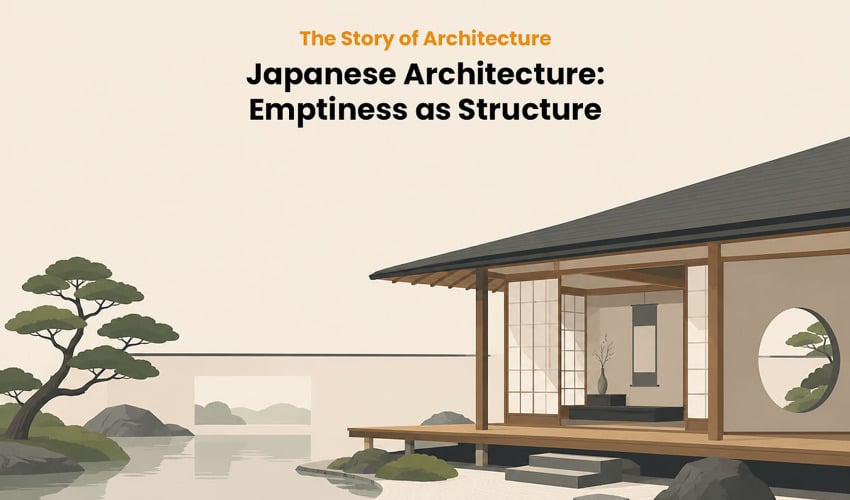
Japanese Architecture: Emptiness as Structure
Get access to all learning content and every RTF Academy course with RTF Academy Pro
The empty room is doing the work.
Learn to see what is not there.
Enter a design culture where restraint speaks louder than ornament and emptiness is a material — lessons that will quietly transform your taste forever.
Emptiness becomes a material you know how to use.
- Value deliberate emptiness — understand space between things as a conscious design act
- Read the tea house — grasp how tiny rooms hold enormous cultural meaning
- Understand flexible rooms — see how screens and mats let a space become many
- Feel material honesty — appreciate wood, paper and shadow used without disguise
- Connect garden and room — learn how inside and outside blur into a whole experience
- Refine your own eye — carry a calmer, sharper sensibility into everything you judge
Built by one of the most-read architecture platforms in the world.
RTF | Rethinking The Future has spent over a decade publishing the ideas, projects and voices shaping architecture — and now brings that depth to learning. Every course is researched, written and produced by the RTF team.
Less is a skill. Acquire it.
A clear path. Five steps.
Everything unlocks instantly with membership · learn at your own pace
If you see yourself here, start today.
A few hours from now, you could already see differently.
I used the word minimalism for Japanese architecture without understanding any of it. The course reframed emptiness, the interval and impermanence as structural ideas rather than aesthetics. My own work has become more restrained since, and for actual reasons this time.
Simple by design.
Watch
Short, focused video lessons — each one a single idea, clearly explained.
Apply
End every lesson with a small task that pushes your real project forward.
Transform
Watch your work develop a point of view that is unmistakably yours.
Answered simply.
Is 'emptiness as structure' just poetic language?
No — it's a concrete design method. You'll see how Japanese architecture uses interval, threshold and restraint as actual organising tools you can apply.
I love Japanese minimalism — will this go deeper than aesthetics?
That's the whole point. The course gets underneath the look to the spatial and cultural logic that produces it.
Do I need any prior experience?
No. Every course starts from where you are and builds up step by step, in plain language.
Is this software training?
No — software changes yearly. The thinking you learn here lasts a career.
How does it work?
Short video lessons with a small practice task after each. Any device, your pace.
What does membership include?
One membership unlocks every course on RTF Academy — all 450+, nothing sold separately. And you stay in control: cancel anytime in one click, and you will never be charged again.
Ready to see your work change?
Your next project could be the one that feels truly yours.
- 5 Sections
- 25 Lessons
- 4 Hours
- 1. The World That Made It5
- 2. What They Built5
- 3. How They Built It5
- 4. The Language5
- 5. What Survived and What It Changed5
Reviews
Online and at your own pace.
Get access to all learning content
and every RTF Academy course with RTF Academy Pro
I used the word minimalism for Japanese architecture without understanding any of it. The course reframed emptiness, the interval and impermanence as structural ideas rather than aesthetics. My own work has become more restrained since, and for actual reasons this time.
You might be interested in
-
0 Students
-
25 Lessons
-
0 Students
-
25 Lessons
-
0 Students
-
25 Lessons
-
0 Students
-
25 Lessons
-
0 Students
-
25 Lessons