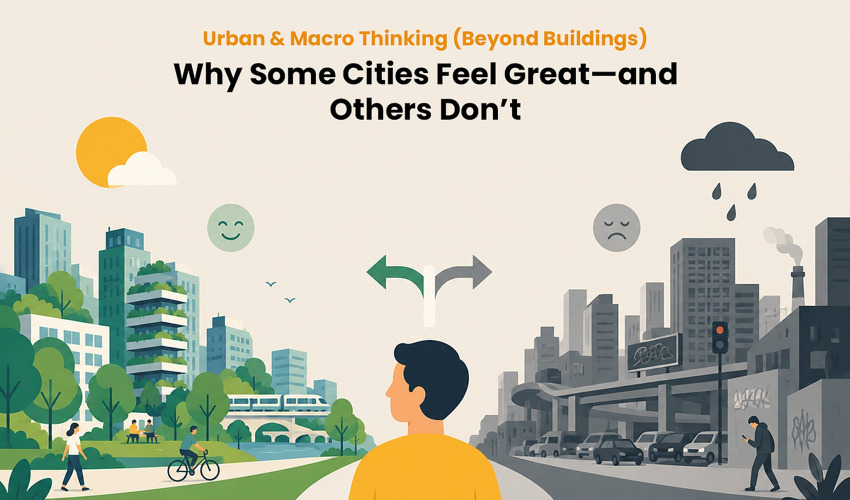
Urban Psychology: Why Cities Feel Good or Bad
Get access to all learning content and every RTF Academy course with RTF Academy Pro
Some places lift you.
Others drain you. There is a reason.
Understand how people actually feel in urban space, and use that knowledge to create places that draw crowds, calm nerves, and earn lasting affection.
You’ll sense why a city feels right or wrong
- Feel spaces like users do — sense the comfort, fear, and delight your designs will trigger
- Explain gut reactions — put clear language to why a place feels safe or hostile
- Design for belonging — create urban spaces people adopt as their own and protect
- Reduce stress by design — shape environments that quietly lower tension for everyone using them
- Win over communities — present proposals grounded in how residents genuinely experience place
- Judge plans by feeling — test any masterplan against the emotions it will actually produce
Built by one of the most-read architecture platforms in the world.
RTF | Rethinking The Future has spent over a decade publishing the ideas, projects and voices shaping architecture — and now brings that depth to learning. Every course is researched, written and produced by the RTF team.
Design for feelings and the city follows.
A clear path. Eight steps.
Everything unlocks instantly with membership · learn at your own pace
If you see yourself here, start today.
A few hours from now, you could already see differently.
Some plazas near my office are always full and others are dead, and I could never explain why beyond guesses. The urban psychology principles here, prospect and refuge, edge preference, sensory load, gave me the explanations and the design levers. I have started applying them to a small streetscape commission and can already predict how people will use each corner.
Simple by design.
Watch
Short, focused video lessons — each one a single idea, clearly explained.
Apply
End every lesson with a small task that pushes your real project forward.
Transform
Watch your work develop a point of view that is unmistakably yours.
Answered simply.
Is urban psychology actually usable in real projects, or just interesting trivia?
It's deeply usable. Once you know why people feel safe, drawn in, or pushed away by a space, you can deliberately design those responses instead of guessing.
I mostly design buildings, not public spaces — is this relevant?
Very. Every building meets the city at its edges, entrances and frontage, and those are precisely the moments this course teaches you to get right.
Do I need any prior experience?
No. Every course starts from where you are and builds up step by step, in plain language.
Is this software training?
No — software changes yearly. The thinking you learn here lasts a career.
How does it work?
Short video lessons with a small practice task after each. Any device, your pace.
What does membership include?
One membership unlocks every course on RTF Academy — all 450+, nothing sold separately. And you stay in control: cancel anytime in one click, and you will never be charged again.
Ready to see your work change?
Your next project could be the one that feels truly yours.
- 8 Sections
- 25 Lessons
- 4 Hours
- Foundations of Urban Psychology3
- Perception and Experience of Cities3
- Public Spaces and Human Interaction3
- Density, Stress, and Mental Health3
- Mobility and Urban Experience3
- Safety, Inclusivity, and Urban Comfort3
- Architecture, Nature, and Happiness3
- Future Urban Experiences4
Reviews
Online and at your own pace.
Get access to all learning content
and every RTF Academy course with RTF Academy Pro
Some plazas near my office are always full and others are dead, and I could never explain why beyond guesses. The urban psychology principles here, prospect and refuge, edge preference, sensory load, gave me the explanations and the design levers. I have started applying them to a small streetscape commission and can already predict how people will use each corner.
You might be interested in
-
0 Students
-
25 Lessons
-
0 Students
-
25 Lessons
-
0 Students
-
25 Lessons
-
0 Students
-
25 Lessons