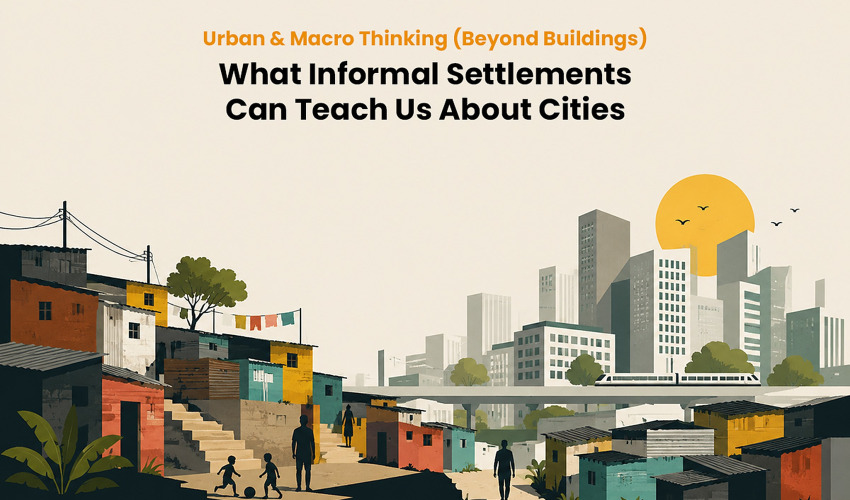
Informal Settlements & Real Urbanism
Get access to all learning content and every RTF Academy course with RTF Academy Pro
Half the world builds without architects.
And it has lessons for you.
Look past textbook cities into how most of humanity actually lives, and gain the grounded urban wisdom that makes your work relevant anywhere on earth.
Informal urbanism will teach you what plans can’t
- Understand unplanned growth — see the logic inside settlements that formal maps ignore
- Respect resident ingenuity — learn from solutions built with almost nothing and total necessity
- Design with communities — work alongside people instead of planning over their heads
- Rethink what works — question polished models that fail the people they claim to serve
- Bring realism to projects — ground ambitious visions in how cities truly grow and adapt
- Expand your practice — open doors to development work most designers cannot even approach
Built by one of the most-read architecture platforms in the world.
RTF | Rethinking The Future has spent over a decade publishing the ideas, projects and voices shaping architecture — and now brings that depth to learning. Every course is researched, written and produced by the RTF team.
Real cities are messy. Real designers understand why.
A clear path. Eight steps.
Everything unlocks instantly with membership · learn at your own pace
If you see yourself here, start today.
A few hours from now, you could already see differently.
Informal settlements were a blind spot my education politely stepped around, yet they are half the urbanism of the country I practice in. This course treats them as functioning systems worth understanding rather than problems to erase. My slum-adjacent housing study now starts from existing livelihood networks, and it is honestly the first urban work of mine I fully believe in.
Simple by design.
Watch
Short, focused video lessons — each one a single idea, clearly explained.
Apply
End every lesson with a small task that pushes your real project forward.
Transform
Watch your work develop a point of view that is unmistakably yours.
Answered simply.
Why should a professional architect study informal settlements?
Because they house a huge share of urban humanity and demonstrate resourceful, adaptive urbanism at work. Understanding them makes you a far more grounded designer in any context.
Is this course judgmental or romanticizing about slums?
Neither. It takes informal settlements seriously as real urbanism — analyzing what works, what fails, and what formal design can honestly learn from them.
Do I need any prior experience?
No. Every course starts from where you are and builds up step by step, in plain language.
Is this software training?
No — software changes yearly. The thinking you learn here lasts a career.
How does it work?
Short video lessons with a small practice task after each. Any device, your pace.
What does membership include?
One membership unlocks every course on RTF Academy — all 450+, nothing sold separately. And you stay in control: cancel anytime in one click, and you will never be charged again.
Ready to see your work change?
Your next project could be the one that feels truly yours.
- 8 Sections
- 25 Lessons
- 4 Hours
- Understanding Informality3
- Growth Patterns and Urban Dynamics3
- Spatial Intelligence of Informal Settlements3
- Social and Economic Ecosystems3
- Infrastructure and Living Conditions3
- Design, Upgrading, and Intervention3
- Policy, Governance, and Rights3
- Future Urbanism and Global Lessons4
Reviews
Online and at your own pace.
Get access to all learning content
and every RTF Academy course with RTF Academy Pro
Informal settlements were a blind spot my education politely stepped around, yet they are half the urbanism of the country I practice in. This course treats them as functioning systems worth understanding rather than problems to erase. My slum-adjacent housing study now starts from existing livelihood networks, and it is honestly the first urban work of mine I fully believe in.
You might be interested in
-
0 Students
-
25 Lessons
-
0 Students
-
25 Lessons
-
0 Students
-
25 Lessons
-
0 Students
-
25 Lessons