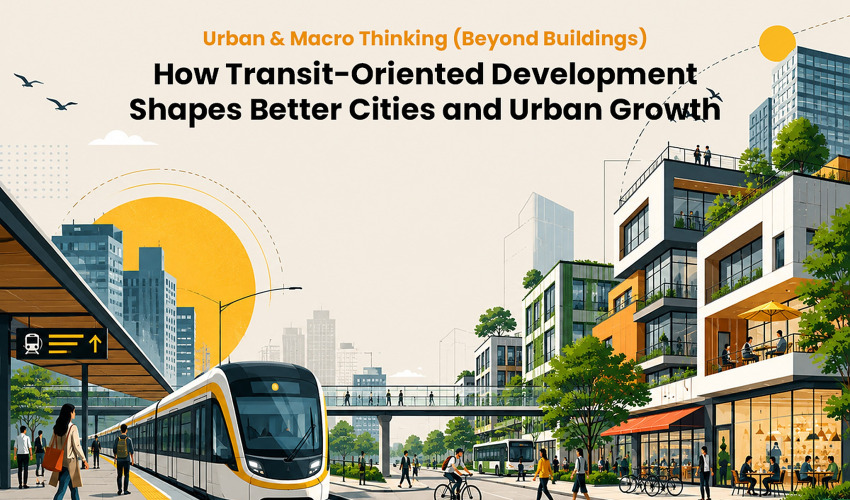
Transit-Oriented Development Explained
Get access to all learning content and every RTF Academy course with RTF Academy Pro
Great cities move people first.
Great designers plan around that.
See how transport shapes everything around it, and learn to position buildings, streets, and neighborhoods where movement turns location into lasting value.
Transit-led projects will make sense to you at last
- Think in networks — connect your site to the flows that feed it life
- Value station areas — recognize why land near transit behaves so differently from elsewhere
- Design the walk — make the journey from platform to doorstep feel completely effortless
- Mix uses around movement — cluster homes, shops, and work where the city already travels
- Speak the planner's language — discuss transit projects with authorities as an informed equal
- Spot tomorrow's hotspots — predict which corridors will transform as new lines arrive
Built by one of the most-read architecture platforms in the world.
RTF | Rethinking The Future has spent over a decade publishing the ideas, projects and voices shaping architecture — and now brings that depth to learning. Every course is researched, written and produced by the RTF team.
Where movement goes, opportunity follows. Learn the map.
A clear path. Eight steps.
Everything unlocks instantly with membership · learn at your own pace
If you see yourself here, start today.
A few hours from now, you could already see differently.
Transit-oriented development was a term I nodded along to in meetings without truly grasping the mechanics. The course walks through catchment logic, density gradients, and land value capture with cases I could actually follow. When a TOD corridor project came into our office last month, I contributed to the planning discussion instead of just the elevations.
Simple by design.
Watch
Short, focused video lessons — each one a single idea, clearly explained.
Apply
End every lesson with a small task that pushes your real project forward.
Transform
Watch your work develop a point of view that is unmistakably yours.
Answered simply.
I don't work on transit projects — does TOD matter to me?
Yes, because transit is reshaping land values and project briefs around every metro corridor. Architects who understand TOD are the ones invited into those conversations.
Is this only relevant to megacities with metros?
No. The core idea — organizing development around movement — applies to bus corridors, railway towns and growing mid-size cities too.
Do I need any prior experience?
No. Every course starts from where you are and builds up step by step, in plain language.
Is this software training?
No — software changes yearly. The thinking you learn here lasts a career.
How does it work?
Short video lessons with a small practice task after each. Any device, your pace.
What does membership include?
One membership unlocks every course on RTF Academy — all 450+, nothing sold separately. And you stay in control: cancel anytime in one click, and you will never be charged again.
Ready to see your work change?
Your next project could be the one that feels truly yours.
- 8 Sections
- 25 Lessons
- 4 Hours
- Introduction to Transit-Oriented Development3
- Principles of TOD Planning3
- Transit Systems and Urban Integration3
- Designing Around Transit Hubs3
- Policy, Economics, and Governance3
- Sustainability and Social Impact3
- Global and Regional Case Studies3
- Future of Transit-Oriented Cities4
Reviews
Online and at your own pace.
Get access to all learning content
and every RTF Academy course with RTF Academy Pro
Transit-oriented development was a term I nodded along to in meetings without truly grasping the mechanics. The course walks through catchment logic, density gradients, and land value capture with cases I could actually follow. When a TOD corridor project came into our office last month, I contributed to the planning discussion instead of just the elevations.
You might be interested in
-
0 Students
-
25 Lessons
-
0 Students
-
25 Lessons
-
0 Students
-
25 Lessons
-
0 Students
-
25 Lessons